Posts

What makes birds special is their ability to fly
Image
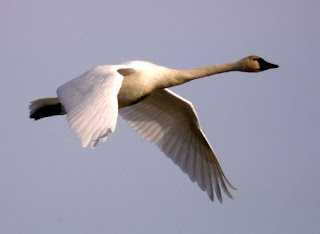
Tundra Swan Some of the advantages of flight : 1) Long distance movements (migration). Resident animals are limited by lower critical seasons. Migrants capitalize on seasonal abundances. 2) Short distance movements local access to food improved. Fruit, flowers, seeds are all patchily distributed, yet 27% of all birds are specialized to eat just these items. In fact, the flowering plants evolved at the same time as did birds, suggesting co-evolution. 3) New feeding modes opened. Flying insects now available (10% of birds specialize in eating flying insects). Flight also offers birds quick access to trees. 4) Escape from predators--(perhaps less important since flying predatory birds appear early on-geologically)

Adaptations for Flight 1

Image
Most bird adaptations are geared toward adaptations to flight: economy of weight, increased power, aerodynamic soundness. To this last concern: a bird's mass is centered at wings and legs (= center of power), the size of limbs, head, and tail are reduced, and body weight is suspended under backbone to enhance stability. Brown Thrasher.  Note the nictitating membrane covering the eye.

Adaptations for Flight 2

1) skeletal a) bones are hollow with internal braces for support the skull is particularly light. b) no teeth c) no bones in tail d) reduction of bones and general fusion of bones e) Study and draw a picture of the bones and feathers of the wings. When studying wings, note especially: humerus, ulna, radius, 2 carpels, carpometacarpus with 3 digits. How does this compare with a human arm? Note also the locations of the following structures: primaries, secondaries, allular quills, under wing coverts, axillars, scapulars, lesser, median, and greater secondary coverts, greater primary coverts. f) Study and draw a picture of the bones of the legs When studying the legs, note: femur, patella, fibula, tibia, tarsometatarsus, hallux (= toe 1), phallanges 2-3-4 (2 being inside).  How does the leg of a bird compare to a human leg? g) other fusion and modification of bones include: 1) pelvic and pectoral girdles are fused (the pelvic is now called the synsacrum); 2) the keel and sternum are m...

Adaptations for Flight 3

Image
Nervous modifications The cerebellum is enlarged (the area of the brain responsible for coordination and balance). In birds, the cerebellum is relatively bigger than in any other animal. Birds' eyes are very large. Proportionally, the eyes are 10-15% larger than people. Some hawks have eyes our size but they have much smaller bodies. Sometimes eyes touch inside the head. The retinas are 1-1.5 % thicker than mammals'. The rods and cones are more abundant in fovea (where cones are concentrated) = million cones/sq. mm (200,000 in people). A hawk's vision is 8x better than a person's. Bird eyes have oil droplets that increase contrast and reduce haze. Hawks and other fast flyers often have 2 fovea: central for side vision, temporal for front vision. Most sensory cells are in upper part of eye. Bird eyes have 2 peculiar features: 1) pectin, a folded vascular structure projecting from optic nerve. The exact funtion is unclear: nutrition and shading? 2) sclerotic ring , ring o...

Adaptations for Flight 4

Image
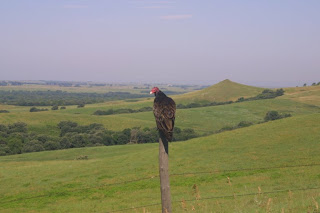
Olfaction and Hearing Most birds have a poorly developed sense of smell don't taste much either, mostly swallow food whole, probably as a weight economy. Kiwi has the best sense of smell. Recent studies have shown than petrels smell their prey out in the ocean. ROBINS EYE WORMS, they don't listen or smell for them. Turkey Vultures smell well and locate carrion that way. Pipe companies have added carrion smell and looked for vultures to find leaks but sight may be more important---in the jungle of Ecuador, I met beetle collectors who buried cans of excrement to catch their insects. Vultures could not see or smell the shit, but quickly gathered around, perhaps cued in by the flies around the cans. EARS. Birds have some of the best hearing of animals, even though they lack pinna (= streamlining). Barn Owls can catch in total darkness. At least two birds use echo-location like bats: Oilbird and Cave Swiftlet. (From the swiftlet comes birds' nest soup: the nests are made of s...

Adaptations for Flight 5

Image
Muscles . Pectoral muscles = 15-40 % of bird's weight (vs. 1-2 % in people—Superman must have been a really strange looking dude). Another difference is that the muscle that pulls the wing back (= supercoracoidius) is attached to the sternum rather than the backbone (= better balance for flying). There are no heavy jaw and facial muscles and no heavy back muscles. EXCRETORY SYSTEM. There is no urinary bladder. DIGESTIVE SYSTEM. Birds eat high energy foods--there are almost no strictly vegetarian birds. They have efficient digestive enzymes. Cedar Waxwing

Adaptations for Flight 6

Image
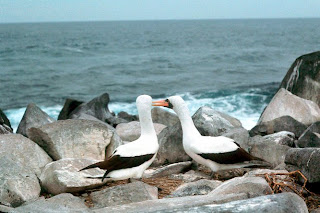
Masked Booby Respiratory and Reproductive Systems . Birds' respiratiory systems contain air sacs w hich are outpockets of the trachea and lungs (a bird can breath through a broken elbow). See a textbook explanation. They comprise, along with lungs, 20% of a bird's body volume. The airsacs allow for a one-way air flow in the lungs, which results in there being no dead space. 1) airsacs cool the bird's high metabolism 2) increase buoyancy  3) cushion gannet -like dives REPRODUCTIVE SYSTEM 1) There is a seasonal regression of gonads (1/1000 reduction in testes size) 2) No live young....rapid egg production 3) One ovary (liver moves centrally for balance); a curious exception may be in hawks, which have two ovaries. So there you have some bird adaptations for flight. Left off is a great deal of avian physiology, a subject I hope to return to now and again